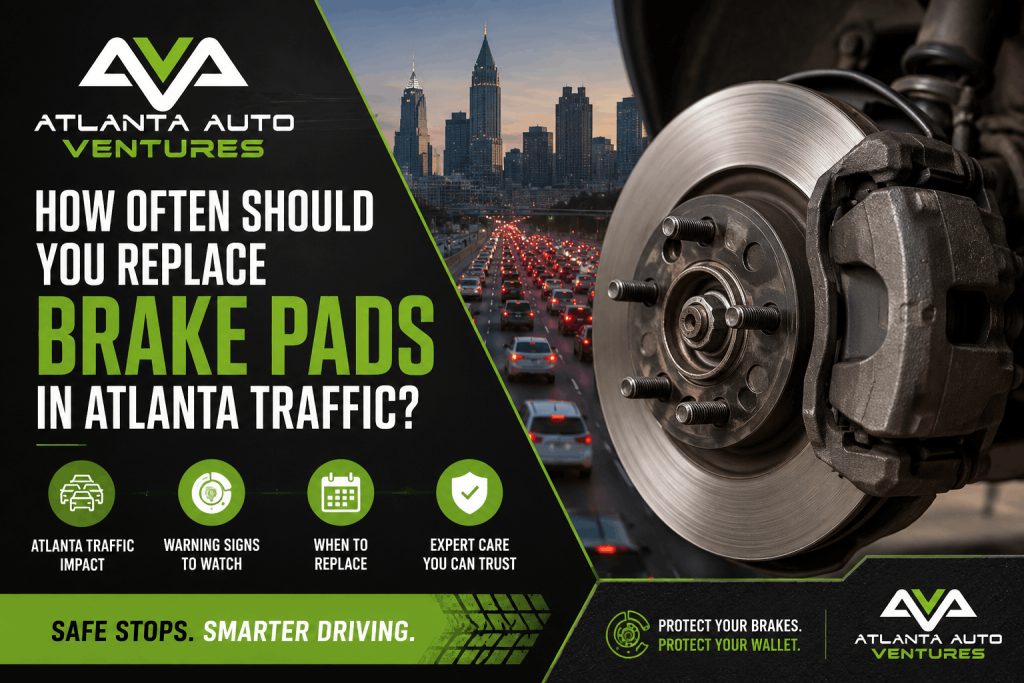
Picture this: it's a Tuesday morning, you're on I-285 near the Perimeter, and traffic has come to a dead stop — again. You tap your brakes, creep forward twenty feet, and tap them again. Repeat for the next forty-five minutes. This is Atlanta driving, and if you haven't thought about what that daily ritual does to your brake pads, it might be time to start.
Brake pads don't wear out on a calendar — they wear out based on how often and how hard you use them. And in a city with Atlanta's traffic density, hilly terrain, and unpredictable stop-and-go patterns, the answer to "how often?" is almost always: sooner than you think.
At Atlanta Auto Ventures, we handle brake repair in Atlanta, GA, every single day — and we've seen firsthand how local driving conditions push brake pads to their limits faster than the national average. This guide will walk you through everything you need to know about brake pad lifespan, warning signs, and when it's time to call for help.
How Atlanta Traffic Wears Down Your Brakes Faster
Here's the basic physics: every time you press the brake pedal, your brake pads clamp against the rotors to create friction, which slows the car down. That friction generates heat. Heat is the enemy of brake pad material. The more times you do this in a given hour, the more heat cycles your pads go through — and the faster they wear down.
In a city like Atlanta, where the Atlanta stop-and-go traffic driving impact on brakes is far greater than it would be in a rural or even suburban environment, you might be pressing your brakes dozens of times in a single mile. Add in Atlanta's rolling hills (especially in Buckhead, Midtown, and the northern suburbs), and your brakes are doing even more work than a driver on flat terrain would expect.
Commuters who drive in heavy traffic daily — think Highway 400, the Downtown Connector, or I-20 near the airport — are putting their pads through stress that someone doing mostly highway miles simply doesn't experience. It's not about how far you drive; it's about how you drive.
The bottom line: Atlanta drivers should not rely on generic brake pad replacement guides. Your environment matters, and your maintenance schedule should reflect it.
Average Brake Pad Lifespan: What the Numbers Actually Tell You
Most manufacturers quote a brake pad lifespan of 25,000 to 70,000 miles — a range so wide it's almost meaningless without context. The average brake pad lifespan in miles depends heavily on three factors: your driving habits, the type of brake pads installed, and the conditions you drive in.
For Atlanta drivers who spend a significant portion of their time in city traffic, the realistic range is closer to 25,000 to 40,000 miles. Highway-focused drivers might stretch that to 50,000 or more. But here's the thing — mileage is only one piece of the picture. Time matters too. A driver who racks up 15,000 miles per year on city streets may need new brake pads after just two years. A driver who does most of their mileage on the interstate might go four or five years before hitting the same wear threshold.
Brake pad material also plays a role. Organic pads are softer and quieter but wear faster — not ideal for stop-and-go Atlanta commuting. Semi-metallic and ceramic pads handle heat better and last longer under demanding conditions, making them a smarter choice for most Atlanta-area drivers. Ask your technician which compound is right for your specific vehicle and driving pattern.
Signs of Worn Brake Pads You Shouldn't Ignore
Your car will usually tell you when something's wrong — you just have to know what to listen for and feel for. These are the most common signs of worn brake pads that Atlanta Auto Ventures sees:
- Squealing or Screeching When Braking:
Most brake pads have a built-in wear indicator — a small metal tab that contacts the rotor when the pad gets too thin, producing a high-pitched squeal. If you hear this sound consistently when braking, don't delay. It's the system doing exactly what it's designed to do: warning you.
- Grinding Noise:
A metallic grinding sound means the pad material has worn through entirely and metal is contacting metal. At this point, you're not just looking at new brake pads — you likely need rotor resurfacing or replacement too. This is significantly more expensive and is entirely avoidable with timely brake repair.
- Pulling to One Side:
If your car drifts left or right when you apply the brakes, it may indicate uneven wear on one side. This could be a stuck caliper, uneven pad wear, or brake fluid issues — all of which require a professional inspection.
- Spongy or Soft Brake Pedal:
A brake pedal that sinks too easily or feels "mushy" often points to air in the brake lines or low brake fluid — sometimes a byproduct of pads that have worn down enough to let the caliper pistons extend further than normal.
- Vibration or Pulsing When Braking:
If your steering wheel or brake pedal vibrates when you stop, your rotors may have developed uneven wear patterns. This is often caused by heat buildup from driving with worn pads for too long.
If you're experiencing any of these symptoms, searching for car brake repair near me is the right instinct — but make sure you're choosing a shop with experienced technicians who will diagnose the full system, not just the pads.
How to Make Your Brake Pads Last Longer in Atlanta
You can't change Atlanta's traffic, but you can change how you drive through it. A few smart habits can meaningfully extend your brake pad replacement frequency and save you money over time.
- Coast before you brake. When you see a red light ahead, take your foot off the accelerator early and let the car decelerate naturally before applying the brakes. This reduces the friction load on your pads and cuts heat buildup.
- Keep a safe following distance. Tailgating forces you to brake harder and more often. Give yourself room, and you'll use the brakes far less aggressively.
- Avoid heavy loads when possible. Extra weight means more force required to stop, which accelerates pad wear. If you regularly haul equipment or cargo, factor that into your maintenance schedule.
- Don't ride the brake pedal. On downhill stretches (common in Atlanta's hillier neighborhoods), engine braking or intermittent firm stops are far less damaging than keeping constant pressure on the pedal.
- Schedule regular inspections. Knowing how to maintain your car braking system starts with visibility. A technician can measure pad thickness and catch wear before it becomes a safety issue.
These aren't complicated habits, but they add up. Drivers who practice smooth, anticipatory braking in city conditions often extend their pad life by 20 to 30 percent compared to those who brake aggressively.
What Does Brake Pad Replacement Cost in Atlanta?
This is the question most drivers want answered before they schedule a service, and it's a fair one. The cost of brake pad replacement in Atlanta typically falls in the following ranges:
|
Service Type |
Typical Cost Range |
Notes |
|
Brake Pads Only (per axle) |
$100 – $200 |
Parts + labor; varies by pad type |
|
Brake Pads + Rotor Resurfacing |
$150 – $280 |
Common if rotors are warped |
|
Brake Pads + New Rotors |
$250 – $450 |
Needed when rotors are beyond resurface limit |
|
Full 4-Wheel Brake Service |
$400 – $700+ |
All pads and rotors replaced |
|
Brake Fluid Flush (add-on) |
$70 – $120 |
Recommended every 2 years |
The earlier you act, the less expensive the repair. A standard brake pad replacement is one of the more affordable services you'll have done on your car. Waiting until you hear grinding means the rotors are now involved — and that cost climbs fast. At Atlanta Auto Ventures, we'll always give you a clear, honest estimate before any work begins. No surprises.
Why Atlanta Auto Ventures for Brake Repair in Atlanta, GA?
When you search for car brake repair near me, you're going to get a long list of options. Here's what makes Atlanta Auto Ventures different: we focus on honest diagnostics, quality parts, and service you can trust.
We don't upsell services you don't need. If your pads need replacing but your rotors are fine, we'll tell you that. If we spot a related issue — a sticking caliper, a brake fluid concern, uneven wear suggesting a suspension problem — we'll let you know and explain it clearly before we do anything.
Our technicians have deep experience with the specific demands Atlanta driving puts on vehicles. We understand what it does to brakes, and we recommend solutions based on your actual driving patterns — not generic manufacturer timelines. Whether you need a quick brake inspection or a full brake repair in Atlanta, GA, we're ready to help.
Hear Squealing? Don't Wait.
Your brakes are the most important safety system on your vehicle. If you've noticed any of the warning signs above — or if you just can't remember the last time you had them checked — Atlanta Auto Ventures is here to help.
Schedule your brake inspection today — fast turnaround, honest diagnosis, no pressure.